
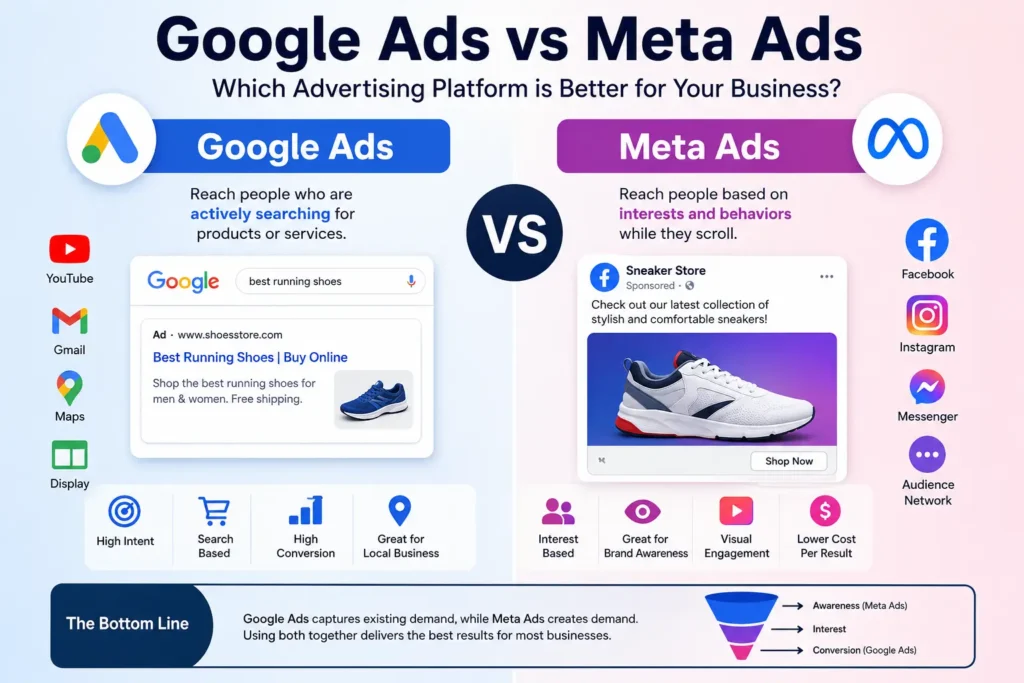
Google Ads vs Meta Ads: Which Advertising Platform Should You Choose?
Digital advertising has become one of the most effective ways for businesses to reach customers online. Whether you own a small local shop or a large online business, paid advertising can help you attract more visitors, generate leads, and increase sales.
But when it comes to online advertising, many business owners ask the same question:
Should I use Google Ads or Meta Ads?
Both platforms are powerful, but they work in different ways. Choosing the right one depends on your business goals, budget, target audience, and the type of products or services you offer.
In this guide, you’ll learn the difference between Google Ads and Meta Ads in simple language. By the end of this article, you’ll know which platform is the better choice for your business.
Table of Contents
- What is Google Ads?
- What are Meta Ads?
- Google Ads vs Meta Ads: Quick Comparison
- Key Differences Between Google Ads and Meta Ads
- Advantages of Google Ads
- Disadvantages of Google Ads
- Which Businesses Should Choose Google Ads?
- (Continued in Part 2)
- Frequently Asked Questions
What is Google Ads?
Google Ads is Google’s online advertising platform. It allows businesses to display advertisements across Google’s services, including:
- Google Search
- Google Shopping
- YouTube
- Gmail
- Google Maps
- Millions of partner websites through the Google Display Network
When someone searches for something like:
- “Best dentist near me”
- “Buy running shoes online”
- “Digital marketing agency”
Google shows paid advertisements above or below the organic search results.
These advertisements appear because advertisers bid on specific keywords.
For example, imagine you own a bakery.
If someone searches for “birthday cake near me,” your advertisement can appear at the top of Google’s search results.
This means you’re reaching people who are already looking for what you sell.
That’s why Google Ads is called intent-based advertising.
The customer already has a need—you simply appear at the right moment.
Types of Google Ads
Google offers several advertising formats.
1. Search Ads
These text ads appear on Google Search results whenever users search for related keywords.
Best for:
- Service businesses
- Local businesses
- Professionals
- High-intent buyers
Example:
Someone searches:
“Emergency plumber near me.”
A plumbing company using Google Ads can appear at the top of the search results.
2. Display Ads
These are image advertisements shown on millions of websites that partner with Google.
Best for:
- Brand awareness
- Remarketing
- Product promotions
3. Shopping Ads
These advertisements display product images, prices, ratings, and store names directly in Google Search.
Best for:
- Ecommerce stores
- Retail businesses
4. Video Ads
These advertisements appear on YouTube before, during, or after videos.
Best for:
- Brand awareness
- Product demonstrations
- Educational content
5. Performance Max Campaigns
Performance Max uses artificial intelligence to show advertisements across all Google platforms using one campaign.
It automatically finds the best audience and placements to improve results.
What are Meta Ads?
Meta Ads are advertisements shown on Meta’s platforms, including:
- Messenger
- Audience Network
Instead of waiting for people to search, Meta shows advertisements based on users’ interests, behaviors, demographics, and online activity.
For example:
Someone may not be searching for a new smartwatch.
But if they frequently browse fitness pages, follow technology influencers, and shop online, Meta may show them an advertisement for a smartwatch.
This is called interest-based advertising.
Meta helps businesses create demand by introducing products and services to people who are likely to be interested.
Types of Meta Ads
Meta provides several advertisement formats.
Image Ads
Simple advertisements using one image and a short description.
Best for:
- Promotions
- Local businesses
- Brand awareness
Video Ads
Videos usually attract more attention than images.
Perfect for:
- Product demonstrations
- Customer testimonials
- Tutorials
Carousel Ads
Businesses can showcase multiple images or products within a single advertisement.
Ideal for:
- Ecommerce
- Fashion
- Travel
- Restaurants
Collection Ads
These advertisements allow customers to browse products without leaving Facebook or Instagram.
Best for:
- Online stores
Reels Ads
Short vertical advertisements placed between Instagram and Facebook Reels.
Excellent for:
- Younger audiences
- Lifestyle brands
- Fashion
- Food
- Beauty products
Google Ads vs Meta Ads: Quick Comparison
| Feature | Google Ads | Meta Ads |
|---|---|---|
| Audience Intent | People actively searching | People discovering products |
| Best For | Leads, sales, local services | Brand awareness, engagement, ecommerce |
| Platforms | Google Search, YouTube, Maps, Display Network | Facebook, Instagram, Messenger |
| Targeting | Keywords + audience signals | Interests, demographics, behaviors |
| Buying Intent | High | Medium to Low |
| Best Content | Search ads, shopping ads | Images, videos, Reels |
| Speed of Results | Often faster for high-intent searches | Depends on creative quality and audience |
| Ideal Businesses | Service providers, B2B, local businesses | Ecommerce, fashion, food, lifestyle brands |
Google Ads vs Meta Ads: Key Differences
1. User Intent
This is the biggest difference.
Google Ads targets people who are already searching for something.
Example:
A person searches:
“AC repair near me.”
They already need the service.
Google Ads helps businesses reach these customers immediately.
Meta Ads work differently.
Users are scrolling through Facebook or Instagram.
They are not actively searching.
Instead, advertisements appear naturally in their feed based on their interests.
Winner:
Google Ads for immediate demand.
Meta Ads for creating demand.
2. Audience Targeting
Google primarily targets people using keywords.
Meta focuses more on audience interests and behaviors.
For example:
A yoga studio could target:
- Women aged 25–45
- Interested in yoga
- Healthy lifestyle
- Meditation
- Fitness
Even if they never searched for yoga classes.
Winner:
Meta Ads.
3. Cost
Many beginners believe Google Ads are always expensive.
That’s not true.
The cost depends on:
- Industry
- Competition
- Location
- Keywords
- Audience
Some industries like insurance or legal services have high costs because many advertisers compete for the same keywords.
Meta Ads often have a lower cost per thousand impressions (CPM), making them a good choice for businesses looking to reach large audiences.
However, lower cost does not always mean better results.
The platform that delivers the highest return on investment (ROI) is usually the better choice.
Winner:
Depends on your business goals.
4. Conversion Rate
Google Ads generally produce higher conversion rates because users are already searching for products or services.
Meta Ads often require multiple interactions before someone decides to purchase.
For example:
A person may see your advertisement today.
Visit your website tomorrow.
Read reviews next week.
Then finally make a purchase.
This customer journey is common with Meta Ads.
Winner:
Google Ads.
5. Brand Awareness
If your goal is to introduce your brand to thousands of people, Meta Ads often perform better.
Creative images, videos, Stories, and Reels can quickly grab attention and encourage users to interact with your brand.
Google Ads can also build awareness through Display and YouTube campaigns, but Meta’s social platforms are naturally designed for content discovery.
Winner:
Meta Ads.
Advantages of Google Ads
1. High Purchase Intent
Google Ads reaches people who are already searching for products or services.
This often results in better-quality leads and higher conversion rates.
2. Faster Leads
Businesses like dentists, lawyers, electricians, digital marketers, and consultants often receive inquiries soon after launching well-optimized search campaigns.
3. Massive Reach
Google processes billions of searches every day.
Your advertisements can also appear across YouTube, Google Maps, Gmail, Shopping, and the Display Network, giving your business access to a huge audience.
4. Excellent Local Advertising
If you run a local business, Google Ads can help you appear when nearby customers search for services “near me.”
This makes it especially useful for restaurants, clinics, repair services, salons, and other location-based businesses.
5. Detailed Performance Tracking
Google Ads provides detailed insights into clicks, impressions, conversions, search terms, and return on ad spend. These reports make it easier to understand what’s working and where you can improve.
Disadvantages of Google Ads
Higher Competition
Popular industries often have many advertisers competing for the same keywords, which can increase advertising costs.
Learning Curve
Choosing the right keywords, setting bids, writing effective ad copy, and optimizing campaigns takes time and practice.
Budget Can Be Wasted
Without proper targeting and ongoing optimization, businesses may spend money on irrelevant clicks that don’t convert into customers.
Limited Demand Creation
Google Ads is excellent at capturing existing demand, but it’s less effective than Meta Ads at introducing completely new products or building awareness among people who aren’t actively searching.
Which Businesses Should Choose Google Ads?
Google Ads works best for businesses where customers are already searching for a product or service. These users have a clear intention to buy, book, or contact a business.
Google Ads is a great choice for:
- Local service businesses like plumbers, electricians, and cleaning services
- Doctors, dentists, and hospitals
- Lawyers and consultants
- Digital marketing agencies
- Real estate companies
- Educational institutions
- Hotels and travel agencies
- Ecommerce businesses selling products people actively search for
Example:
Imagine you own a dental clinic.
A person searches for “best dentist near me.”
If your Google Search Ad appears at the top, there’s a good chance they’ll visit your website or call your clinic because they already need a dentist.
Advantages of Meta Ads
Meta Ads have become one of the most popular advertising platforms because they help businesses reach people before they even start searching.
1. Powerful Audience Targeting
Meta allows advertisers to target people based on:
- Age
- Gender
- Location
- Interests
- Behaviors
- Hobbies
- Job titles
- Online shopping habits
This makes it easier to reach the right audience.
2. Excellent Brand Awareness
Facebook and Instagram users spend a lot of time scrolling through content every day.
Creative advertisements can introduce your brand to thousands of potential customers.
3. Visual Storytelling
Unlike Google Search Ads, Meta Ads rely heavily on visuals.
High-quality images and videos can quickly grab attention and increase engagement.
4. Great for Ecommerce
Meta Ads work especially well for online stores.
Features like:
- Product Catalog Ads
- Collection Ads
- Dynamic Remarketing
help businesses recover abandoned carts and increase sales.
5. Lower Starting Budget
Small businesses can often start Meta Ads with a modest daily budget.
This makes it an attractive option for startups and entrepreneurs who want to test advertising before scaling.
Disadvantages of Meta Ads
Lower Purchase Intent
People using Facebook or Instagram are usually browsing for entertainment, not shopping.
This means they may not be ready to buy immediately.
Creative Quality Matters
A poorly designed image or video may receive little attention.
Successful Meta campaigns often require strong visuals and compelling copy.
Results May Take Longer
Since users aren’t actively searching, it may take several interactions before they trust your business enough to make a purchase.
Frequent Platform Changes
Meta regularly updates its advertising features and algorithms, so advertisers need to monitor performance and adapt their campaigns.
Google Ads vs Meta Ads: Which Is Better for Different Businesses?
The answer depends on your business goals.
| Business Type | Recommended Platform | Why? |
|---|---|---|
| Local Services | Google Ads | People actively search for these services. |
| Ecommerce Stores | Both | Google captures demand, while Meta creates demand. |
| Restaurants | Both | Google helps with “near me” searches, and Meta showcases food visually. |
| Fashion Brands | Meta Ads | Eye-catching visuals perform well. |
| Educational Institutes | Google Ads | Students actively search for courses. |
| Real Estate | Both | Google generates inquiries, while Meta builds awareness. |
| Beauty Products | Meta Ads | Visual content influences buying decisions. |
| B2B Companies | Google Ads | Professionals often search for solutions online. |
Can You Use Google Ads and Meta Ads Together?
Absolutely!
In fact, many successful businesses use both platforms because they complement each other.
Here’s a simple example:
Step 1: A user sees your Instagram ad while scrolling.
Step 2: A few days later, they search for your business on Google.
Step 3: Your Google Search Ad appears.
Step 4: They visit your website and make a purchase.
This approach allows you to build awareness first and capture buying intent later.
Real-World Example
Imagine Sarah owns a handmade candle business.
She launches Meta Ads showcasing beautiful lifestyle photos and short videos of her candles. Thousands of people discover her brand while browsing Instagram.
A week later, someone remembers her products and searches “handmade scented candles online.”
Sarah’s Google Shopping Ad appears at the top of the search results.
The customer clicks the ad and places an order.
In this example:
- Meta Ads created interest.
- Google Ads captured the purchase.
Using both platforms together created a stronger customer journey.
Common Mistakes to Avoid
Many businesses don’t get the results they expect because they make a few common mistakes.
Avoid these:
- Choosing a platform just because it’s popular.
- Targeting everyone instead of a specific audience.
- Ignoring keyword research in Google Ads.
- Using low-quality images or videos in Meta Ads.
- Not installing conversion tracking.
- Sending traffic to a slow or confusing website.
- Stopping campaigns too early without enough data.
- Failing to test different headlines, visuals, or audiences.
Advertising works best when you measure results and keep improving your campaigns.
Google Ads vs Meta Ads: Final Verdict
There isn’t one platform that’s better for every business.
Choose Google Ads if your goal is to generate leads or sales from people who are actively searching for your products or services.
Choose Meta Ads if your goal is to build brand awareness, grow your audience, and inspire people to discover your products.
If your budget allows, using both platforms together often delivers the best results. Meta Ads introduce your brand, while Google Ads help convert interested users into paying customers.
The key is to match your advertising strategy with your business goals rather than following trends.
Conclusion
Google Ads and Meta Ads are both powerful digital marketing tools, but they serve different purposes.
Google Ads connects your business with people who already know what they need. Meta Ads introduces your business to people who may not have heard of you yet.
Instead of asking, “Which platform is better?”, ask yourself:
- Do I want people to discover my brand?
- Or do I want to reach people who are already searching for what I offer?
Your answer will guide your decision.
For many businesses, the best strategy isn’t choosing one platform over the other—it’s using both together to create a complete marketing funnel that builds awareness, earns trust, and drives conversions.
Frequently Asked Questions (FAQs)
1. What is the main difference between Google Ads and Meta Ads?
Google Ads targets people who are actively searching for products or services, while Meta Ads target people based on their interests, behaviors, and demographics.
2. Which platform is better for small businesses?
It depends on your goals. Google Ads is ideal for generating immediate leads, while Meta Ads are excellent for increasing brand awareness and reaching new audiences.
3. Are Google Ads more expensive than Meta Ads?
Not always. Advertising costs depend on your industry, competition, targeting, and campaign quality. A well-optimized campaign on either platform can deliver excellent value.
4. Which platform has a higher conversion rate?
Google Ads often have higher conversion rates because users already have purchase intent when they search.
5. Can I use Google Ads and Meta Ads together?
Yes. Many businesses combine both platforms to build awareness through Meta Ads and capture demand through Google Ads.
6. Which platform is better for ecommerce?
Using both is often the best strategy. Meta Ads help customers discover products, while Google Shopping Ads capture buyers who are ready to purchase.
7. Is Meta Ads only for Facebook?
No. Meta Ads can appear on Facebook, Instagram, Messenger, and the Audience Network.
8. Which platform is better for local businesses?
Google Ads is generally better because it targets people searching for nearby products or services.
9. How much should I spend on ads?
Your budget depends on your goals and industry. Many small businesses start with a manageable daily budget, monitor performance, and gradually increase spending as they see positive results.
10. Which advertising platform should beginners start with?
If people already search for your service, start with Google Ads. If you want to introduce a new product or build brand awareness, begin with Meta Ads.
About the Author
I’m Femina Usman, a Freelance Digital Marketing Strategist in Thrissur with expertise in SEO, Google Ads, Meta Ads, Social Media Marketing, and content strategy. I enjoy helping businesses improve their online presence through search engine optimization, targeted advertising, and data-driven marketing strategies that generate quality leads and long-term growth.
Through this blog, I share practical digital marketing tips, beginner-friendly guides, and the latest industry insights to help business owners and marketers make informed decisions. I aim to simplify complex marketing topics so that anyone can understand and apply them.
If you’re looking to increase your website traffic, generate more leads, or build a stronger online presence, I’d be happy to help.
📩 Let’s connect: Visit www.feminausman.com to learn more about my digital marketing services or get in touch for a consultation.