
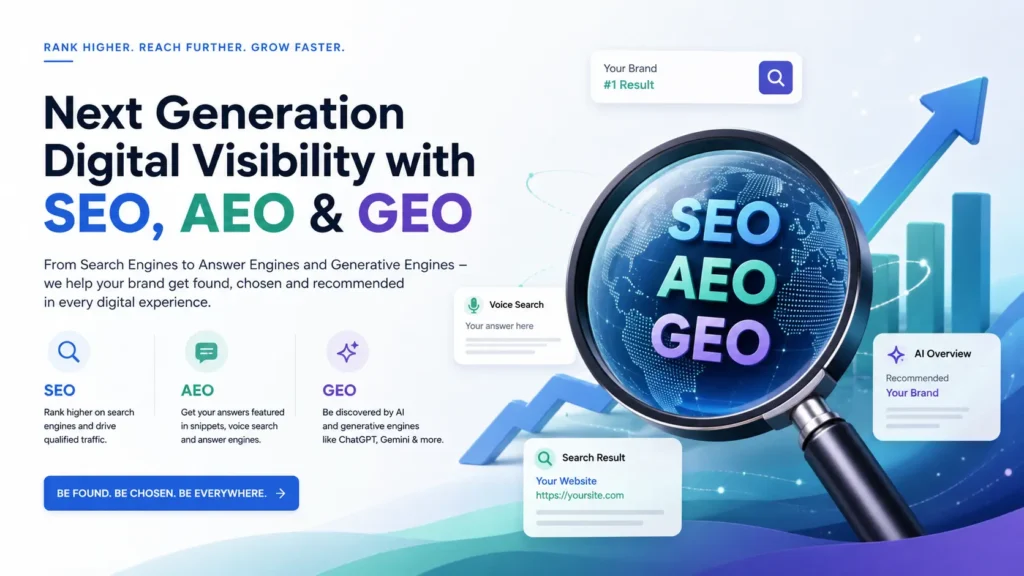
SEO vs AEO vs GEO: The Evolution of SEO
The way people search for information online is changing rapidly.
A few years ago, people would open Google, type a keyword, and click through several websites to find the answer they needed. Today, users expect immediate answers. They ask voice assistants questions, use AI tools like ChatGPT, and rely on search engines that provide direct answers without requiring multiple clicks.
Because of this shift, businesses, marketers, and website owners need to understand three important concepts:
- SEO (Search Engine Optimization)
- AEO (Answer Engine Optimization)
- GEO (Generative Engine Optimization)
While SEO has been the foundation of digital marketing for many years, AEO and GEO are becoming increasingly important as AI-powered search experiences continue to grow.
In this guide, we will explain SEO, AEO, and GEO in simple language that even an 8th-grade student can understand.
What is SEO?
SEO stands for Search Engine Optimization.
SEO is the process of improving a website so that it appears higher in search engine results when people search for relevant topics.
Simple Example
Imagine you own a bakery.
When someone searches:
“Best chocolate cake near me”
You want your bakery website to appear on the first page of Google.
SEO helps make that happen.
Why is SEO important?
Most people click on the first few results they see.
If your website appears lower on the search results page, fewer people will visit it.
Good SEO helps:
- Increase website traffic
- Improve visibility
- Generate leads
- Build trust
- Increase sales
How Does SEO Work?
Search engines like Google use bots to:
- Crawl websites
- Understand content
- Store information in their index
- Rank pages based on relevance and quality
The better your content and website structure, the higher your chances of ranking.
Key Elements of SEO
Keyword Research
Finding the words people search for online.
Example:
On-Page SEO
Optimizing website content.
Examples:
- Page titles
- Headings
- Meta descriptions
- Internal links
- Images
Technical SEO
Improving website performance.
Examples:
- Fast loading speed
- Mobile-friendly design
- Secure website (HTTPS)
- Proper site structure
Off-Page SEO
Building authority through external signals.
Examples:
- Backlinks
- Brand mentions
- Online reviews
What is AEO?
AEO stands for Answer Engine Optimization.
AEO focuses on making content easy for search engines and AI systems to understand and present as direct answers.
Instead of simply ranking a page, the goal is to become the answer itself.
Why is AEO Important?
Today, people often ask complete questions such as
- What is digital marketing?
- How does SEO work?
- What causes stress?
- How can I improve my mental health?
Google, Siri, Alexa, and AI tools try to provide direct answers immediately.
AEO helps your content get selected as the answer.
Example of AEO
Suppose someone searches:
“What is SEO?”
Google may display a featured snippet:
“SEO is the practice of optimizing websites to improve visibility in search engines.”
The user gets the answer instantly.
The website that provided that answer is benefiting from AEO.
How Does AEO Work?
Answer engines look for:
- Clear questions
- Direct answers
- Structured content
- Trusted sources
- Schema markup
The easier your content is to understand, the better your chances of being selected.
Best Practices for AEO
Use question-based headings.
Examples:
- What is SEO?
- How does SEO work?
- Why is AEO important?
These help search engines understand user intent.
Provide Short Answers First
Give the answer immediately.
Example:
What is SEO?
SEO is the process of improving a website’s visibility in search engine results.
Then provide detailed explanations.
Add FAQ Sections
FAQ sections are excellent for answer engines.
Example:
What is SEO?
SEO improves website visibility on search engines.
What is AEO?
AEO helps content become a direct answer.
What is GEO?
GEO helps AI systems use and cite your content.
Use bullet points.
Answer engines prefer easy-to-read content.
Examples:
- Clear
- Structured
- Organized
Content performs better.
What is GEO?
GEO stands for Generative Engine Optimization.
GEO is the process of optimizing content for AI systems, such as:
- ChatGPT
- Gemini
- Claude
- Perplexity
- Microsoft Copilot
Instead of showing links, these systems generate answers.
GEO helps your content become part of those AI-generated responses.
Why is GEO important?
Search behavior is changing.
Many users now ask AI tools directly:
“What are the services provided by a freelance digital marketer?”
Instead of receiving ten website links, they receive one generated answer.
The AI gathers information from multiple trusted sources and creates a response.
GEO helps ensure your content becomes one of those trusted sources.
Example of GEO
A user asks ChatGPT:
“Who is the best freelance digital marketer in Tharissur?”
The AI may generate an answer using information found online.
If your content is well-structured and trustworthy, AI systems are more likely to use it.
How Does GEO Work?
Generative AI systems prefer content that is:
- Accurate
- Clear
- Well-structured
- Up-to-date
- Trustworthy
They also favor content with strong expertise and authority.
GEO Best Practices
Write Conversational Content
People ask AI tools questions naturally.
Example:
Bad:
“Stress Management Services Bangalore”
Good:
“How can a digital marketer help business growth?”
Cover Topics Completely
AI prefers comprehensive content.
Instead of writing one short paragraph, explain the following:
- What
- Why
- How
- Benefits
- Examples
Demonstrate Expertise
Show:
- Real experience
- Qualifications
- Case studies
- Testimonials
This improves trust.
Keep Information Updated
AI systems value fresh information.
Update content regularly.
SEO vs. AEO vs. GEO: What is the Difference?
| Feature | SEO | AEO | GEO |
|---|---|---|---|
| Full Form | Search Engine Optimization | Answer Engine Optimization | Generative Engine Optimization |
| Main Goal | Rank higher in search results | Become the direct answer | Become part of AI-generated answers |
| Platform | Google, Bing | Google Snippets, Voice Search | ChatGPT, Gemini, Claude |
| Focus | Keywords and rankings | Questions and answers | AI understanding and citations |
| User Action | Clicks’ website | Reads the answer instantly | Gets an AI-generated response |
| Content Style | Keyword-focused | Question-focused | Conversational and comprehensive |
| Importance Today | Very High | High | Growing Rapidly |
Which One is Better: SEO, AEO, or GEO?
The truth is
None of them replaces the others.
They work together.
Think of them as a team.
SEO Gets You Found
Your website appears in search results.
AEO Makes You the Answer
Your content appears in featured snippets and voice search.
GEO Helps AI Recommend You
Your content becomes part of AI-generated responses.
The best strategy is to use all three.
How SEO, AEO, and GEO Work Together
Imagine you publish an article:
“How to Manage Stress Naturally”
SEO
Helps the article rank on Google.
AEO
Helps Google display a featured snippet.
GEO
Helps ChatGPT and Gemini use the content when answering related questions.
One piece of content can benefit from all three strategies.
What is Schema Markup?
Schema markup is code added to a webpage that helps search engines understand content more clearly.
Think of it as a label.
It tells search engines:
- This is an article
- This is an FAQ.
- This is a person
- This is a business
- This is a review
Why is Schema Markup Important?
Schema markup helps:
- Improve search visibility
- Support featured snippets
- Enhance AEO performance
- Improve AI understanding
- Increase GEO opportunities
Best Schema Markup Types for SEO, AEO, and GEO

FAQ Schema
Used for question-and-answer sections.
Example:
Question:
What is SEO?
Answer:
SEO is the practice of optimizing websites for search engines.
Article Schema
Used for blog posts.
Helps search engines understand:
- Title
- Author
- Date
- Content
Organization Schema
Used for businesses.
Includes:
- Business name
- Website
- Logo
- Contact details
Person Schema
Useful for coaches, consultants, and experts.
Includes:
- Name
- Expertise
- Qualifications
- Website
How to Write Content for SEO, AEO, and GEO Together
Follow this simple structure:
Step 1: Start with a Question
Example:
What is SEO?
Step 2: Give a Short Answer
SEO is the process of improving website visibility in search engines.
Step 3: Provide a Detailed Explanation
Explain the topic thoroughly.
Step 4: Add Examples
Examples make content easier to understand.
Step 5: Add FAQs
FAQ sections improve AEO and GEO.
Step 6: Use Schema Markup
Help machines understand your content.
Frequently Asked Questions
What is SEO?
SEO is the process of improving a website so it appears higher in search engine results.
What is AEO?
AEO is the practice of optimizing content so answer engines can display it as a direct answer.
What is GEO?
GEO is the process of optimizing content for AI-powered search and generative engines.
Is SEO Still Important?
Yes.
SEO remains the foundation of online visibility and digital marketing.
Can AEO Replace SEO?
No.
AEO works alongside SEO rather than replacing it.
Can GEO Replace SEO?
No.
GEO expands content visibility into AI-powered platforms but still depends on strong SEO fundamentals.
Why Are Businesses Talking About GEO?
Because AI-powered search tools are growing rapidly and changing how users find information.
Do I Need Schema Markup?
Yes.
Schema markup improves machine understanding and supports SEO, AEO, and GEO strategies.
Conclusion
Search is evolving faster than ever before.
Traditional SEO helps websites rank on search engines.
AEO helps content become the direct answer users see.
GEO helps AI systems understand, trust, and use your content when generating responses.
The future of digital visibility is not choosing between SEO, AEO, or GEO.
It is combining all three.
Businesses that create clear, helpful, structured, and trustworthy content will have the best chance of succeeding across Google, voice assistants, and AI-powered platforms.
If you want your content to remain visible in the future, start optimizing not only for search engines but also for answer engines and generative AI engines.
The future belongs to content that can be found, understood, and trusted.
Looking to grow your online presence? Visit my blog page for expert content on digital marketing, SEO, content strategy, and AI-driven search optimization.
Pingback: Proven Digital Marketing Tips for Local Business in 2026